
CHAPTER THREE
God told Gideon his army was too large.
This is not how military strategy usually works. You don’t win battles by reducing your forces. You don’t defeat a coalition of 135,000 Midianite and Amalekite raiders—“thick as locusts”, the text says, their camels beyond counting—by sending men home. But that is precisely what God tells Gideon to do, and He explains why with a candor that should make every man who has ever taken credit for his own victories sit down and get quiet.
“You have too many men. If I let all of you fight the Midianites, the Israelites will boast to me that they saved themselves by their own strength.” (Judges 7:2)
The thinning is not strategic. It is theological. God is removing the possibility of the wrong explanation for the victory.
First cut: anyone who is afraid may leave. Twenty-two thousand go home. Ten thousand remain. Still too many. Second cut: bring them to the water. Watch how they drink. Those who cup the water to their mouths with their hands—alert, heads up, weapon-ready even while drinking—stay. Those who kneel and put their faces down to the stream—lowering their guard completely—go. Three hundred men cup the water. The rest are sent home.
Three hundred against 135,000.
The math is not the point. The math is the setup for the lesson.
What Gideon Actually Was
Before any of this, there is the scene at the winepress.
Gideon is threshing wheat inside a winepress—hiding it from the Midianites, who have been raiding Israelite harvests for seven years. The angel of the Lord appears and greets him: “The Lord is with you, mighty warrior.” (Judges 6:12)
The greeting is almost sardonic given the circumstances. Gideon is hiding in a hole. He is the youngest son of the weakest family in the weakest clan of his tribe. He is frightened, and his first response to the divine commission is a list of objections: My clan is the weakest. I am the least in my family. Where are all the miracles our ancestors told us about? If the Lord is with us, why has all this happened?
This is not the speech of a man who feels equipped for what he’s being called to do.
And God does not argue with him. God does not say: Actually, Gideon, when I look at your life I see tremendous untapped potential. He says: “I will be with you.” (v. 16) That’s the whole answer. Not a revised assessment of Gideon’s abilities. Not a promise of smooth passage. Just the presence.
This is the bedrock principle of endurance: it is not drawn from the size of the man. It is drawn from the identity of the God accompanying him. Which is why the army needs to be reduced to three hundred — so that when the Midianites rout in the night, terrified by torches and ram’s horns and the sound of breaking clay pots, no one makes the mistake of thinking the Israelites were just better soldiers.
The Hajduk Method
In the Dinaric Alps and the forests of the Šumadija, the Serbs under Ottoman occupation developed a tradition of resistance that military historians now study as a model of asymmetric warfare.
The hajduks were outlaws in the technical sense — men who refused to accept the terms of Ottoman domination and took to the forests and mountains instead. They operated in small bands called čete, rarely numbering more than a dozen fighters. They lived off the land. They moved at night. They struck supply columns, freed prisoners, harassed administrators, and disappeared before reprisals could be organized. They were, in the language of modern military doctrine, a distributed insurgency with minimal infrastructure and maximum local knowledge.
They were also, in a deep sense, a spiritual phenomenon.
The hajduk was not simply an outlaw. He was a protector of the Christian population that could not protect itself. His code — the hayduk code, transmitted through oral tradition and observed imperfectly but consistently across generations — required hospitality, honor toward women and children, and a commitment to the Orthodox faith that distinguished him from simple brigandry. The hajduk leader was often godfather to the children of the villages he protected. He was integrated into the community’s spiritual life even as he lived outside its legal structures.
The Ottoman empire, with all its institutional weight, could not extinguish the hajduks. It suppressed them, hanged them, offered amnesties, launched punitive expeditions. And they came back. They came back because the forest is large and the mountains are old and the faith that sustained them was older than any empire.
Three hundred men with torches and clay pots. A dozen men in the forest with old rifles and a knowledge of the terrain. The same principle operating across three thousand years: you do not need to match the enemy’s numbers. You need to be willing to endure longer than the enemy is willing to pursue.
Valley Forge: The Winnowing
December 1777. General George Washington leads twelve thousand Continental soldiers into winter quarters at a plateau called Valley Forge, twenty miles northwest of British-occupied Philadelphia.
What follows is six months that nearly ended the American experiment.
The men arrive without sufficient food, clothing, or shelter. Washington writes to the Continental Congress that some regiments are without shoes; he can track the army’s march in the snow by the blood from bare feet. By February, nearly three thousand men are unfit for duty — sick, starving, or both. Disease kills more soldiers than British muskets did during the entire preceding campaign season. Washington estimates that at one point he cannot put together five hundred men fit to fight.
And yet.
Washington does not dissolve the army. He does not release the men to go home until spring. He keeps them there, in the cold, and he brings in Friedrich von Steuben — a Prussian drillmaster who speaks almost no English but communicates discipline in a language that transcends language. Von Steuben teaches the ragged Continentals how to march in formation, how to reload under fire, how to use a bayonet, how to function as a coordinated military unit rather than an armed mob.
The twelve thousand who entered Valley Forge in December and the eight thousand who marched out in June were not the same army in any meaningful sense. The cold had killed the weak ones and the quitters. The ones who remained had been forged.
Not improved. Forged.
There is a metallurgical difference. Improvement is incremental — a little better, a little stronger, built up over time through positive accumulation. Forging is violent transformation — metal heated past the point of comfort, hammered until its internal structure reorganizes around the stress, cooled in a new shape that it will now hold. You cannot forge metal without the fire. You cannot forge a man without the trials that are hot enough and sustained enough to reorganize his interior.
“We also glory in our sufferings, because we know that suffering produces perseverance; perseverance, character; and character, hope.” (Romans 5:3–4)
Paul is not celebrating suffering for its own sake. He is describing a specific causal chain: suffering → perseverance → character → hope. Each link requires the previous one. You cannot skip to the hope without the suffering. You cannot build the character without the perseverance. The chain holds, and it holds in order.
The Simulation: Seven Days
The chapter outline calls for a practical trial — a seven-day rationed discipline, honoring both Halyard’s hidden trails and the forge-logic of Gideon and Valley Forge.
Here is the structure.
Days 1–2: Fast from one comfort. Choose the thing you reach for most automatically when you’re stressed or bored or lonely. Not the most dramatic thing — the most automatic one. Put it down for two days. Pay attention to what surfaces when it’s gone. That’s what it was suppressing.
Days 3–4: Physical load. Carry something extra. An early morning run with a weighted pack. Manual labor you’ve been postponing. An hour in the cold. The body needs to remember that it can function under conditions it doesn’t prefer.
Days 5–6: Solitude and silence. Two hours daily, no phone, no music, no content. A Bible and a journal. Gideon’s three hundred were men who stayed alert even while drinking from the stream — practice the alertness. Pay attention to what comes up in the quiet.
Day 7: Assessment. Write down what you learned. Specifically: what broke on Day 1 that was still broken on Day 6? What did you discover you could handle that you didn’t think you could? Where did God show up in the difficulty?
This is not asceticism for its own sake. It is a controlled test of the forge. A week of voluntary discomfort is not Valley Forge — not even close — but it uses the same mechanism: it removes the options and reveals the man.
What Endurance Builds That Nothing Else Does
There is a quality that only comes through sustained difficulty — not a single hard moment, but the long haul of a trial that does not resolve on schedule.
Call it settledness.
It is the quality of a man who has been tested long enough to know what he is made of, who has discovered both his breaking points and his recovery capacity, who is no longer startled by difficulty because difficulty has become a familiar country. He doesn’t enjoy it. He is not performing stoicism. He simply knows, from the evidence of his own life, that he has come through before and that coming through is possible.
This is what Paul is describing when he writes from his Roman prison with inexplicable contentment — “I have learned the secret of being content in any and every situation” (Philippians 4:12). Note the word: learned. Not given. Not natural. Acquired through a curriculum that included shipwrecks, beatings, imprisonments, a thorn in the flesh, and forty years of opposition from people he was trying to help.
The hajduk who has survived three winters in the forest is a different man from the one who volunteered in the spring. The Continental soldier who marched out of Valley Forge in June is a different man from the one who stumbled in the previous December. The difference is not primarily skill, though skill improved. The difference is knowledge — the bone-deep, unshakeable knowledge that I can endure this. Because I have.
No one can give you that knowledge. It can only be earned. And the enemy knows this, which is why the enemy’s primary tactic is not to destroy you in a single assault but to wear you down through prolonged siege — sustained discouragement, incremental compromise, the slow erosion of vision by the mundane weight of days that don’t seem to matter.
Stand anyway.
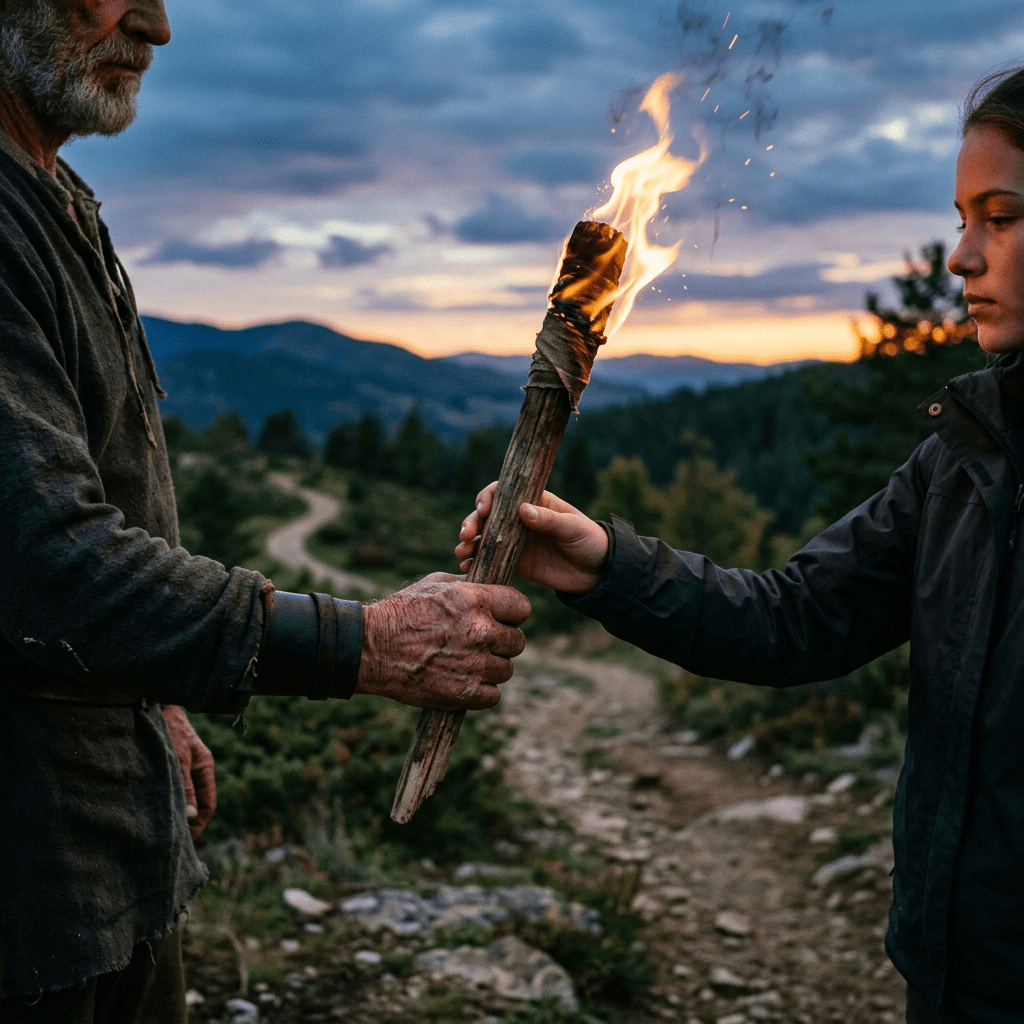
The three hundred jars are ready. The torches are lit. The signal is coming.
A Prayer in the Trench
Lord, I am not what I need to be yet. The army You’re building in me still has too many men who will run at the first hard thing, too many who kneel and put their faces to the water without watching. Keep thinning it. I don’t want to win by my own strength and claim the credit. I want the victory that can only be explained by Your presence.
On the days when endurance is the only option, remind me of the causal chain: suffering, perseverance, character, hope. Remind me that the forge is not my enemy. It is the method.
I ask for enough faith to hold. Not enough to see the end — just enough for the current mile. In the name of the One who endured the cross for the joy set before Him. Amen.
“The Lord said to Gideon, ‘With the three hundred men that lapped I will save you.’” — Judges 7:7



 Lazarevic Ministries