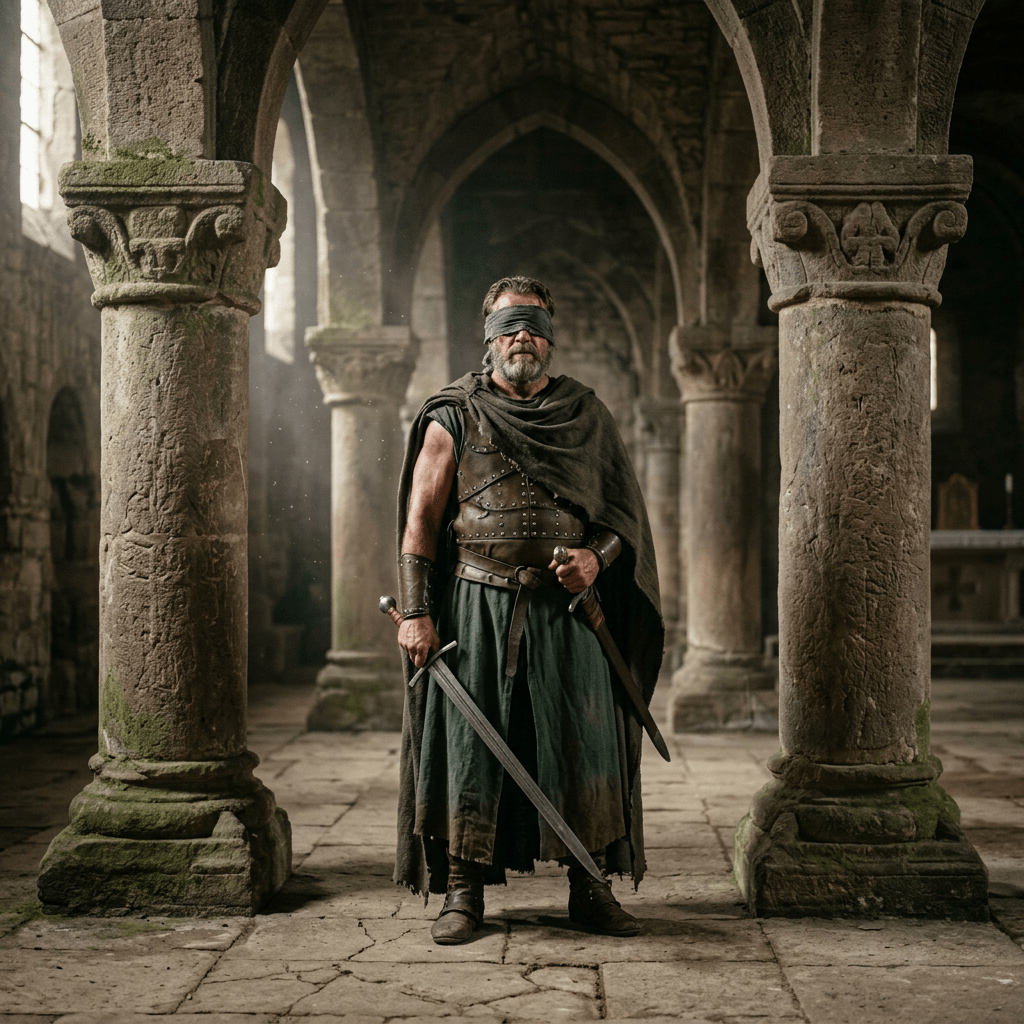
ANOINTED FOR ASSAULT: GOD’S FORGE OF THE WARRIOR
Before Samson was born, God had already picked a fight.
The angel didn’t appear to Manoah and his wife to announce a blessing in the ordinary sense—a healthy child, a long life, a full harvest. The announcement in Judges 13 is military in its precision: “He will take the lead in delivering Israel from the hands of the Philistines.” (v. 5) The child in the womb already has a mission. The mission has been assigned from above. The mother’s instructions—no wine, no unclean food, the Nazirite vow—are not customs. They are the making of a weapon.
This is the first thing to understand about calling: it precedes you.
You did not choose the blood in your veins. You did not choose the century you were born into, the tradition that shaped your first understanding of God and manhood, the particular enemies that occupy the field of your generation. These things were arranged before you had any say in the matter. Your job is not to design the weapon. Your job is to be one.
The Nazirite Paradox
The Nazirite vow was a life set apart. No razor to the head, no wine or fermented drink, no contact with the dead. On the surface, it looks like a list of prohibitions—a religion of “no.” But underneath the restrictions is a different logic: you belong to something larger than your appetites.
Every culture that has ever produced great warriors has understood this principle in some form. The Spartans didn’t eat what they wanted. Japanese samurai observed disciplines that governed every hour of the day. Monks in medieval Serbia—men like those at Hilandar on Mount Athos, where the Nemanjić dynasty sent its sons—lived under a rule that organized body, mind, and spirit toward a single purpose. The constraint was not the enemy of strength. The constraint was the condition of it.
Samson struggles with this his entire life.
He sees a Philistine woman and wants her. His parents protest; he pushes through. He touches a dead lion’s carcass to get the honey inside, breaking the vow. He visits a prostitute in Gaza. He falls for Delilah, who asks him the source of his strength no fewer than four times, and each time gets closer to the truth. The final time, he tells her. The Philistines take him in the night, gouge out his eyes, bind him in bronze shackles, and set him to work grinding grain in a prison in Gaza.
The man anointed before birth for the deliverance of Israel ends up blind, chained, and mocked.
If Samson’s story ended there, it would be a warning. But his hair begins to grow.
The Architecture of a Fall
Before we get to the end of the story, it’s worth sitting with the middle—because the middle is where most men live.
Samson’s failures are not random. They follow a pattern that should be uncomfortably familiar.
He treats his gifting as unconditional. The strength is there every time he needs it—in the lion’s path, against the thirty Philistines at Ashkelon, with the jawbone of a donkey at Lehi where he kills a thousand men in a single engagement. The victories come so consistently that Samson stops thinking about what they cost. He begins to treat divine power as a personal possession rather than a trust. And trusts, when violated, are revoked.
He mistakes desire for direction. Every significant compromise in Samson’s life begins the same way: he sees something he wants, and he goes after it without asking whether he should. “Get her for me,” he tells his parents about the Timnite woman. “She’s the right one for me.” (Judges 14:3) He is confusing appetite with calling. A man who cannot distinguish between the two will eventually follow his appetites off a cliff.
He keeps getting to the edge. Delilah’s four attempts at extracting his secret are not four separate incidents. They are one escalating decision, made incrementally. He could have left after the first lie he told her. He could have left after the second. Each time he stayed, the exit became harder to reach. This is how the serious mistakes happen—not in a single dramatic choice, but in the accumulated weight of small ones, each one moving you slightly closer to the place you shouldn’t be.
These patterns don’t belong to Samson alone. They are the architecture of every serious fall a man of faith can take. The gifted man who mistakes his gift for a guarantee. The strong man who cannot govern his own desire. The man who keeps returning to the edge, telling himself he can handle it, until one night he can’t.
Name the pattern in your own life before we go any further. Because Samson’s story only becomes useful when you stop reading it as history and start reading it as a mirror.
Marko Kraljević: The Hero at the Edge
Serbian tradition has its own version of this archetype.
Marko Kraljević—son of King Vukašin, born around 1335—occupies a unique position in Serbian epic poetry. He is simultaneously the greatest hero in the cycle and the most morally complicated. He is strong beyond natural measure, armed with his famous sabre and his wine-stained mace, mounted on his horse Šarac who is as much a character as his rider. He slays dragons, defeats Ottoman champions in single combat, and rescues the oppressed from tyrants.
He also has a weakness for wine. He disobeys his mother. He sometimes fights on the wrong side—most historically, as a vassal of the Ottomans, which cost him the field at Kosovo where he might have tipped the balance. The epics don’t hide these things. They place them next to the heroism and let them stand in tension, because the tradition understood something that sanitized hagiography misses: the same man can be both great and flawed, and the greatness does not cancel the flaw, and the flaw does not cancel the greatness.
What makes Marko ultimately admirable in the Serbian tradition is not that he overcomes all his weaknesses—he doesn’t, fully—but that he remains committed to what is right even when it costs him. When he fights for the Ottomans and sees that God’s favor is moving in the other direction, he makes his peace with it. Tradition holds that he wept over his own situation, trapped between political obligation and moral clarity, and chose to fall on the side of justice even at the price of his own life.
He is, in the end, a man who knows his contradictions and keeps moving anyway.
There is something useful here for every man who has looked at the distance between who he is and who he’s supposed to be, and felt the gap as an indictment. Marko Kraljević says: carry the gap with you onto the field. Don’t let it make you a spectator.
The Tesla Problem
In 1884, a twenty-eight-year-old Serbian engineer named Nikola Tesla arrived in New York with four cents in his pocket, a poem he’d written, and a letter of introduction to Thomas Edison.
The letter—from Charles Batchelor, Edison’s representative in Paris—reportedly said: “I know two great men and you are one of them; the other is this young man.”
Tesla went to work for Edison in lower Manhattan, putting in eighteen-hour days on the Edison Machine Works’ equipment. He was prodigiously gifted, immediately useful, and profoundly misaligned with his employer. Edison believed in direct current. Tesla had seen—theoretically, in a vision that came to him while walking in a Budapest park—the complete design for an alternating current motor. He knew, with the certainty that genuine insight carries, that AC was the future of electrical power. It could be transmitted over long distances. It would change everything.
Edison was not interested.
Tesla left. He spent time digging ditches to pay his bills. He found new backers, built his AC motor, and licensed the technology to George Westinghouse. The resulting “War of Currents” was ugly—Edison ran a public disinformation campaign against AC power, electrocuting animals in front of audiences to demonstrate its “dangers”—but Tesla and Westinghouse won. The Niagara Falls power station was built on Tesla’s design. The electrical grid that lit the 20th century ran on alternating current.
The man who spent time digging ditches in Manhattan put the lights on across a continent.
What is the point for us?
The point is that calling doesn’t protect you from obscurity. Tesla’s gift was enormous and verifiable and it still required years of poverty, years of working for the wrong employer, years of fighting against the institutional weight of an established competitor who had more money and more public credibility. The gift did not come with a guarantee of smooth passage. It came with a direction and the equipment to eventually get there.
This is what men who carry genuine calling need to understand. The anointing is real. The path is not marked. You will have your ditch-digging seasons. They are not signs that the calling was wrong. They are part of the forge.
What the Forge Actually Does
Paul writes from prison—not for the first time—to a young pastor named Timothy: “God did not give us a spirit of timidity, but a spirit of power, of love and of self-discipline.” (2 Timothy 1:7)
Three things. Power, love, self-discipline.
Note what is not on the list: certainty, comfort, a smooth road, recognition, an absence of enemies. Paul knew what Timothy was facing—the same thing Paul was facing, the same thing every generation of serious Christians has faced: a world that does not want what they carry, and will use varying degrees of force to take it from them.
The forge—that period of testing, restriction, obscurity, failure, and recovery—is where those three qualities are actually built. Not announced. Built.
Power without love becomes brutality. It’s Samson using his gift for personal vengeance rather than national deliverance. It’s the strong man who never learned to govern himself and so never learned to serve others. It’s enormous capacity directed at small targets.
Love without self-discipline becomes sentimentality. It’s good intentions that collapse under the first real pressure. It’s the man who is warm and generous until it costs him something, at which point the warmth evaporates because it was never grounded in anything durable.
Self-discipline without love becomes cold machinery. It’s the man who has mastered himself but mastered himself for nothing—an impressive structure with no one living inside.
The forge produces all three, together, by working them against each other. Love under pressure teaches you what you actually care about. Power under constraint teaches you what it’s for. Self-discipline under the weight of real suffering teaches you that you are capable of more than you thought, and that the capability was never really yours to begin with.
Samson’s Last Act
Here is what the story has been building toward.
Samson is in the prison at Gaza. Blind. Chained. Grinding grain like a mill animal, the great judge of Israel reduced to a thing that performs a function. The Philistines bring him out for a festival to mock him before three thousand people packed into the temple of Dagon. “Bring out Samson to entertain us.” (Judges 16:25)
A boy leads him to the pillars.
Samson asks the boy to position him where he can lean against them.
Then he prays—for the first time in the entire narrative, Samson prays with a fully surrendered heart. “Sovereign Lord, remember me. Please, God, strengthen me just once more.” (v. 28)
Not for himself. “Let me with one blow get revenge on the Philistines for my two eyes.” But the revenge here is not the point—the point is what the prayer reveals. Samson finally, at the end of his story, submits. He has no more strength of his own. He has no options. He is blind and chained and surrounded by enemies who are laughing at him. And in that complete emptiness, he asks.
He braces against the two central pillars. He pushes.
“He killed many more when he died than while he lived.” (v. 30)
This is the paradox at the center of Christian warrior theology, and it runs from Samson straight through to the cross: the greatest victories are sometimes won in the moment of complete surrender. Not surrender to the enemy—surrender to God. The letting go of the self-managed strength that was always a loan anyway, in exchange for something that cannot be taken.
Lazar made this choice the night before Kosovo. He surrendered the earthly kingdom to take hold of the heavenly one, and in doing so became more dangerous than any tactician calculating survival odds could have been.
Paul made it in the prison in Philippi, singing at midnight with Silas, chains rattling in an earthquake that opened every door, and the jailer falling at his feet before dawn.
Tesla made a version of it when he walked away from Edison—walked away from the security and the salary and the established institutional path—because to stay would have required betraying the truth he carried. He went to dig ditches instead. The ditches led to Niagara.
Building Your Arsenal
The chapter introduction describes this as “charting your hybrid arsenal.” This is a practical discipline, not just a metaphor.
Samson had physical strength beyond normal men. Marko Kraljević had strength, a famous horse, a network of alliances, and deep knowledge of both Serbian and Ottoman cultures—which made him effective in ways that pure loyalists couldn’t be. Tesla had a mind that generated complete mechanical systems in visual space before he ever touched metal.
What is yours?
Not what do you wish you had. What do you actually possess?
This requires honest assessment from two directions:
Serbian inheritance (if applicable): What specific qualities do you carry from that tradition? The capacity for endurance under prolonged adversity—centuries of occupation produced in Serbian culture an extraordinary patience, a rootedness that survives upheaval. The hayduk instinct—the guerrilla’s ability to operate without institutional support, to improvise, to use the terrain. The Kosovo commitment—the capacity to choose the harder right over the easier wrong, even when the cost is enormous.
American inheritance: The frontier ethic—self-reliance, practicality, the conviction that problems exist to be solved. The Protestant work theology—the dignity of labor, the calling embedded in daily work. The constitutional instinct—the innate suspicion of concentrated power and the defense of individual conscience against it. The evangelical tradition—the insistence on personal encounter with God, unmediated by institution.
Now: where do these things meet in you?
Because the intersection is where your particular weapon lives. Not the Serbian version alone, which can become insular and grievance-driven without the American capacity for forward motion. Not the American version alone, which can become restless and rootless without the Serbian capacity for depth and endurance.
Forge exercise: Write two lists.
List one: Three qualities you have demonstrated under real pressure—not qualities you aspire to, but qualities that have actually appeared when things were hard. Ask a person who knows you well to confirm or correct your list. The ones that survive that conversation are real.
List two: Three ways you have treated your gifting carelessly—the Samson pattern. Where have you assumed that the strength would be there regardless of how you lived? Where have you confused your appetite with your direction? Where have you kept returning to the edge?
The gap between those two lists is the work of this chapter. Not to shame you—Marko Kraljević never stopped carrying his contradictions, and God used him anyway—but to show you precisely where the forge needs to apply heat.
The Vow of the Nazirite
The Nazirite vow was not fundamentally about hair or wine or avoiding the dead. It was about singularity of purpose. I belong to this. The restrictions were the expression of a commitment that ran deeper than the rules themselves.
Every man who carries a genuine calling needs his own version of this.
Not necessarily the same restrictions Samson observed—though sobriety and sexual integrity and a careful relationship with death and violence are not bad starting points. But the discipline that says: this life is organized around something larger than my comfort. My choices are not made solely on the basis of what I want. I belong to a calling, and the calling has requirements.
Samson’s tragedy was not that he had the vow. His tragedy was that he slowly, incrementally, treated the vow as negotiable—until the night Delilah finally took what he’d been offering piece by piece for years.
The commitment you make in this chapter is to stop negotiating.
Not because you’ll never fail again. You will. Marko failed. Paul failed—he writes in Romans 7 about the war between what he wants to do and what he finds himself doing, with a rawness that should comfort every man who has ever known that war. The commitment is not to perfection. It is to orientation. To keep your face pointed toward the right thing, and when you turn away—as you will—to turn back.
A Prayer Before the Forge
Lord, I was made for something before I understood what it was. I have not always handled the gift well. I have treated strength as unconditional and desire as direction, and I have paid for it, and in some cases others have paid for it beside me.
I want to be the man at the pillars at the end—not the man grinding in the prison, not the man asleep in Delilah’s lap. I want the surrendered strength, the power that knows what it’s for.
Show me what I actually carry. Show me where I’ve been careless with it. Give me the Nazirite clarity—the single purpose that organizes a life. And when the ditch-digging seasons come, as they will, hold the vision.
In the name of the One who turned the worst defeat in history into the only victory that matters. Amen.
What Comes Next
Chapter Three takes us to Gideon.
If Samson is the cautionary tale about a man who had everything and nearly wasted it, Gideon is the unexpected story of a man who had nothing—or thought he had nothing—and became the instrument of a victory that required him to get smaller so that God could operate through him without the credit being stolen.
Gideon’s three hundred. The hajduks in the Dinaric passes. Valley Forge. What these have in common is not the size of the force but the quality of the commitment—and the willingness to let the numbers be reduced until what remains is pure.
The enemy banks on your feeling outnumbered. God sometimes arranges it deliberately.
Get some sleep. The morning is coming fast.
“The Spirit of the Lord came powerfully upon him.” — Judges 14:6




 Lazarevic Ministries