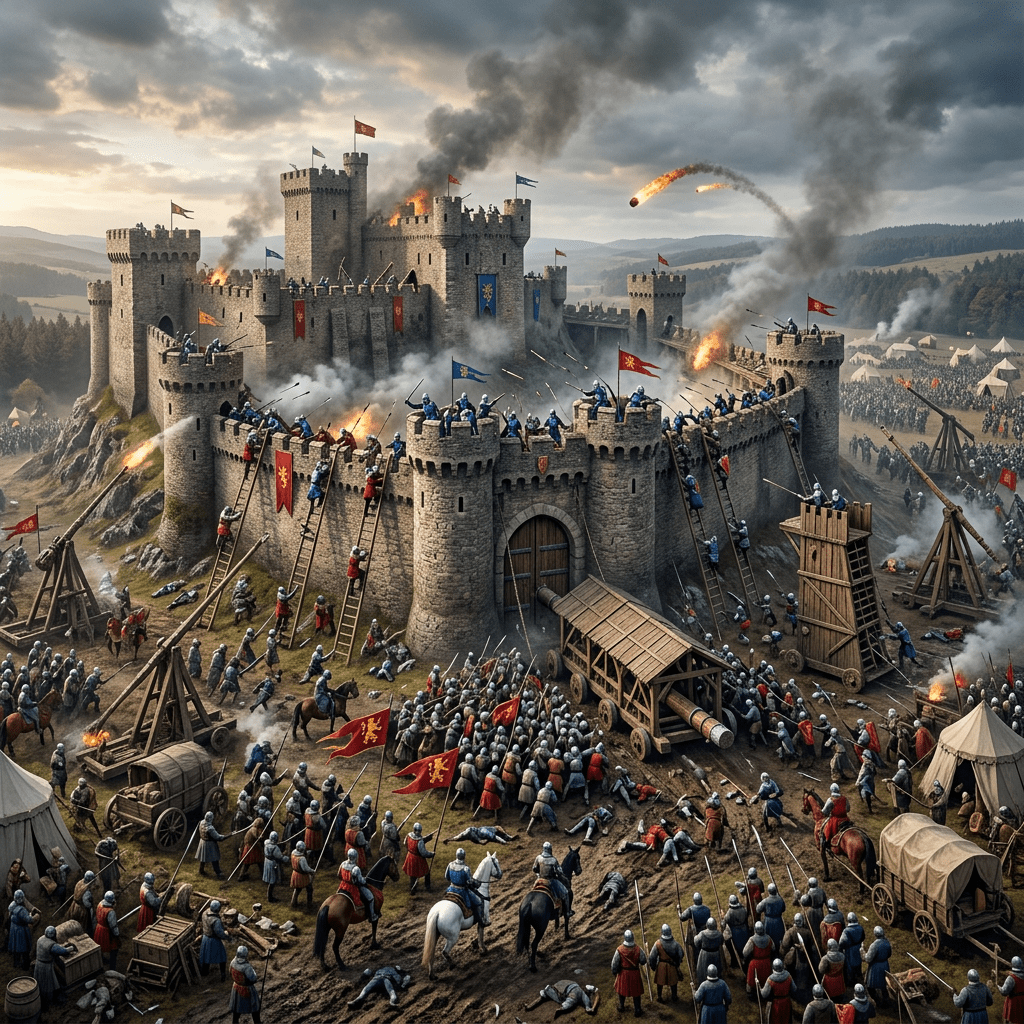
THE SIEGE OF THE SOUL: IDENTIFYING YOUR GOLIATHS
Dawn breaks over Kosovo Polje on June 15, 1389—Vidovdan, the Day of St. Vitus—and it comes in silence before it comes in sound.
First, the birds stop. Then the horses feel it through their hooves: a tremor in the earth, low and steady as a millstone, the accumulated weight of thirty thousand men moving into position across the Field of Blackbirds. The Ottoman army under Sultan Murad I has been marching since before first light. Their drums begin at sunrise—not to signal an advance, but to make the waiting worse. Psychological warfare, ancient-style: feel us before you see us. Know what’s coming.
On the Serbian side of the field, Prince Lazar Hrebeljanović hears those drums and finishes his prayer.
The Man in the Field
Lazar is not a man born to mythology. He’s a practical man—a border lord who clawed his way to prominence through decades of skirmishes and political survival in the fragmenting ruins of the Nemanjić empire. He has buried friends along the Danube. He has stared down Hungarian envoys and Tatar raiders alike. His hands are rough from reins and from the calluses of a rosary worn smooth by years of genuine use.
Around his neck: a silver cross, double-headed eagle, the mark of his dynasty’s faith.
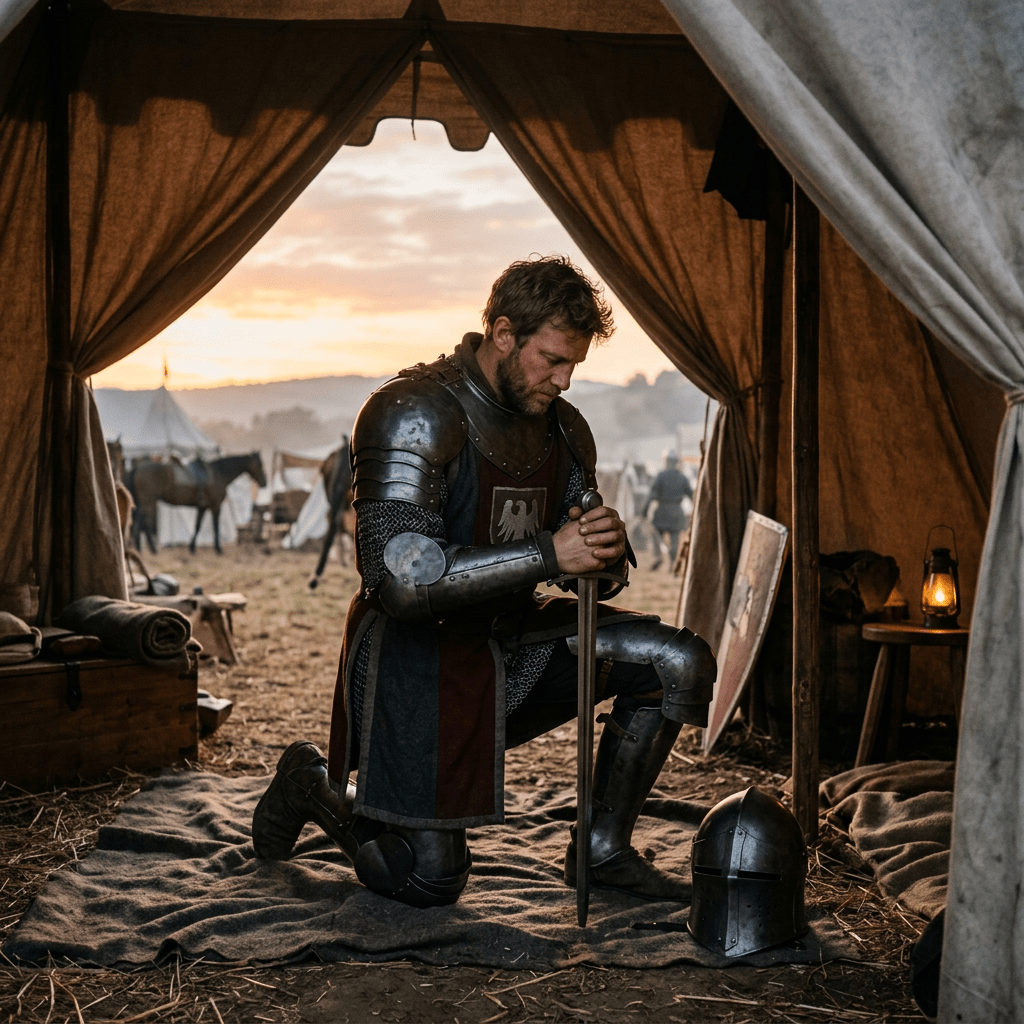
The night before, he knelt before a tattered icon in his war tent and received what Serbian tradition has preserved as a vision—an angelic messenger laying out the choice in plain terms. Victory today means earthly dominion: empire, but empire purchased with the soul of a people. Defeat today, chosen willingly, means something else. Martyrs’ crowns in a kingdom that outlasts all empires.
“We will not choose the kingdom of this earth,” Lazar told his captains, “but the kingdom that endures beyond the stars.”
Whatever theological framework you bring to that story, the choice itself is historically real in its shape: Lazar could have submitted. He could have paid tribute, accepted Ottoman sovereignty, preserved his life and his throne in the way that dozens of lesser lords had before him. He chose the field instead.
This is not a man who miscalculated the odds. He counted them. He charged anyway.
What He Faced
Across the field, Murad I has spent a lifetime reducing kingdoms to provinces. Born to the Ottoman throne in 1326, he has swallowed Bulgaria, humbled Byzantium, and turned the Balkans into a corridor for Muslim expansion into the heart of Europe. His army—estimates range from twenty to forty thousand, with Lazar’s force numbering perhaps half that—includes the janissaries: an elite corps of men who began life as Christian boys taken in the devşirme, the levy of children from conquered lands, stripped of their names and their faith, drilled from boyhood into the most disciplined infantry in the medieval world.
These were not ordinary soldiers. They were a system’s product—what happens when an empire invests decades in turning human beings into weapons.
And Murad, astride his black stallion on the ridge above the field, watches with the calm of a man who has done this before.
The Parallels Run Deep
Four hundred and forty-seven years later, on a cold February morning in 1836, a smaller but spiritually identical drama plays out in the Texas desert.
The Alamo—a mission turned fortress—holds roughly 180 men. Mexican General Santa Anna has arrived with two thousand soldiers and a blood-red flag signaling no quarter. Colonel William Travis sits by lantern light and writes: “I shall never surrender or retreat… Victory or Death.”
The men inside that compound have every opportunity to escape or submit. They don’t. Davy Crockett plays his fiddle in the evening, and the music drifts over the walls into the Mexican camp. Jim Bowie, sick with fever, has himself carried to a position where he can still swing a rifle. When the final assault comes on March 6, they sell the ground at a price Santa Anna didn’t want to pay.
Six weeks later, Sam Houston’s army catches Santa Anna at San Jacinto. The battle lasts eighteen minutes. The war cry is three words: Remember the Alamo.
The Alamo lost. But it won something that cannot be counted on a map.
The Heart of the Pattern
Here is what Lazar and Travis have in common, across all those centuries and miles:
They had already decided before the battle began.
The deciding—the real act of will—happened in the tent the night before, at the writing desk in the lantern light. It happened when a man looked at what he faced, counted the cost honestly, and chose to stand anyway. Not from recklessness. Not from a failure to understand the odds. But from a conviction that some things matter more than survival.
This is the warrior’s first discipline: clarity about what you’re fighting for.
Not bravado. Not adrenaline. Not the vague, testosterone-fueled sense that you ought to be doing something heroic. Clarity. The kind that only comes when you’ve been honest with yourself about the field, about the enemy, about what you’re actually willing to give.
David had it when he walked toward Goliath in the valley of Elah. The giant had been shouting for forty days, and the entire Israelite army—Saul’s professional soldiers, men who’d fought in actual wars—had been paralyzed by it. Not David. David had spent years alone with God in the fields, defending sheep from lions and bears with his bare hands. By the time he stood at that valley, he wasn’t performing courage. He was operating from conviction.
“You come against me with sword and spear and javelin,” he said to the nine-foot giant, “but I come against you in the name of the Lord Almighty.” (1 Samuel 17:45)
That’s not bravado. That’s intelligence. David had assessed the field correctly: the most important variable in any fight is not the size of the enemy but the identity of the God you’re fighting for.
Your Kosovo Field
The Goliaths you face don’t wear armor. That’s what makes them harder.
A man on the other side of a valley with a spear is, in some ways, easier to deal with than the enemies that occupy the interior of your own life. You can see him. You know where he is. You can load your sling and walk toward him.
Your Goliaths may be less visible. But they are not less real.
Apathy is a Goliath. The slow, comfortable surrender of a man who has swapped the fight for the couch—not all at once, but inch by inch over years, until he wakes up one morning and doesn’t recognize the person in the mirror. He’s still alive. He’s just stopped charging.
Addiction is a Goliath. Whether it’s alcohol, pornography, or the endless dopamine drip of a screen—addiction is Philistine chains worn voluntarily. It promises relief and delivers captivity. The man who cannot govern his own appetites cannot govern anything else, and the enemy knows this.
Fear is a Goliath. Not the healthy fear that keeps you from stepping off a cliff, but the corrosive kind—the fear of failure, of rejection, of being seen and found wanting. The voice that says who are you to lead? To love? To stand? This voice has been with men since the Garden. It is not new, and it is not unique to you, and it is not as powerful as it sounds.
Doubt is a Goliath. The sly internal backstab: does any of this matter? Is faith real, or is it just the story your grandmother told you? This is not a question to be answered by suppressing it. It’s a question to be taken into the field with you and worked out in the living of a principled life, until the evidence accumulates and doubt finds it has less and less territory to occupy.
Cultural drift is a Goliath. The slow, ambient pressure of a world that wants you passive, distracted, and manageable—that labels your protective instincts “dangerous,” that mocks your faith as unsophisticated, that would rather have a consumer than a man. This one is patient. It doesn’t need to defeat you in a single charge. It just needs to keep nudging the line until you’ve ceded the field without ever realizing there was a battle.
The Scout’s Discipline
Before David loaded his sling, he watched. He asked questions. He gathered intelligence. The first thing 1 Samuel 17 tells us is that David heard Goliath—heard the taunts, understood what was being offered and what was at stake, and asked the officers around him: What will be done for the man who kills this Philistine and removes this disgrace from Israel? (v. 26)
This is not the move of an impulsive kid. This is a scout doing his reconnaissance.
Lazar, the night before Kosovo, did the same. He held a council. He looked at his numbers. He assessed his flanks—including Vuk Branković, whose loyalty was already suspect and whose betrayal the following day would crack the Serbian right and seal Lazar’s fate.
You need to do the same. Not with someone else’s Goliaths—with yours.
Scout exercise: Sit with a piece of paper and write down the five things in your life that have the most power to stop you from becoming the man you know you’re supposed to be. Don’t perform. Don’t write the answer you’d give in a men’s group. Write what keeps you up at 3 a.m. What do you avoid? What do you know needs to change but haven’t changed? What are you walking around rather than through?
These are your Goliaths. Name them. Because a Goliath you haven’t named is a Goliath with all the advantages. He knows who he is. He’s been shouting from that ridge for a long time. The moment you name him, the moment you say there he is, that’s the thing I’m fighting—the dynamic shifts. You stop being the prey and start being the hunter.
Kosovo’s Legacy in the Blood
Serbian identity—the deep, marrow-level kind, not the flag-waving kind—was shaped by what happened on the Field of Blackbirds. Not only by the loss, but by the choice that preceded it.
Every Serbian child who grew up hearing the Kosovo cycle—those epic poems transmitted by guslars for six hundred years before being written down—absorbed something through the rhythm and the story: there is a kingdom that matters more than any earthly throne, and a man who grasps this is not diminished by defeat. He is completed by faithfulness.
This is why the 1990s war—the breakup, the sieges, the horror of what neighbors did to each other—did not destroy Serbian faith. It couldn’t. The template for surviving the unsurvivable had been built in 1389 and reinforced in every century since: against the Ottomans, against the Habsburgs, against the Nazis, against Tito’s atheist machinery. The faith went underground. The crosses were carved into doorframes. The prayers were murmured in the dark. The roots went deeper.
That stubborn, underground, inextinguishable root is your inheritance. It is in your blood if you carry Serbian heritage. It is available to you if you have been formed by this tradition, even from a distance. And it meets, in this book and in history, the parallel inheritance of the American frontier—that Calvinist-inflected, Bible-saturated, freedom-gripping faith that built Plymouth, crossed the Alleghenies, planted churches before it planted towns, and produced men like Joshua Chamberlain, who held Little Round Top with bayonets when the ammunition ran out and who later wrote theology about what he’d seen.
Two traditions. One root. One fight.
The Vidovdan Vow
There is a tradition among Serbian men of renewing the Kosovo covenant—the commitment to the heavenly kingdom over the earthly one, the choice of faithfulness over expediency.
It’s a fitting thing to do at the beginning of this work.
Not a dramatic ceremony. Just a man and his God, in the quiet before dawn, looking honestly at the field and making the choice before the drums start.
Pray this, or something like it, in your own words:
Lord, I name the Goliaths in front of me: [name them]. I have been walking around them. Today I stop. I don’t have a guarantee of victory in the terms the world would recognize. Lazar didn’t have one either. But I choose the kingdom that endures. I choose to stand on this field, to hold this line, to not negotiate with what I should be fighting. I am not enough for this on my own. But You have not asked me to be. Give me the scout’s eye, the warrior’s nerve, and the saint’s surrender. In Christ, who rose from the worst defeat in history and turned it into the only victory that matters. Amen.
What Comes Next
In Chapter Two, we take the field.
We look at Samson—a man anointed before birth for a specific fight, who nearly wasted it, and whose final act of surrender became his greatest weapon. We look at what it means to be called rather than merely motivated, and why the difference between those two things determines whether your strength holds under real pressure.
We also look at what Nikola Tesla can teach a Christian man about carrying a gift that doesn’t fit the world you were born into—and refusing to shrink it anyway.
The enemy is on the ridge. He’s been there a long time. He’s counting on you to keep being impressed by his size.
Load the stone.
“Do not be afraid of them; the Lord your God himself will fight for you.” — Deuteronomy 3:22


 Lazarevic Ministries