Chapter Eight
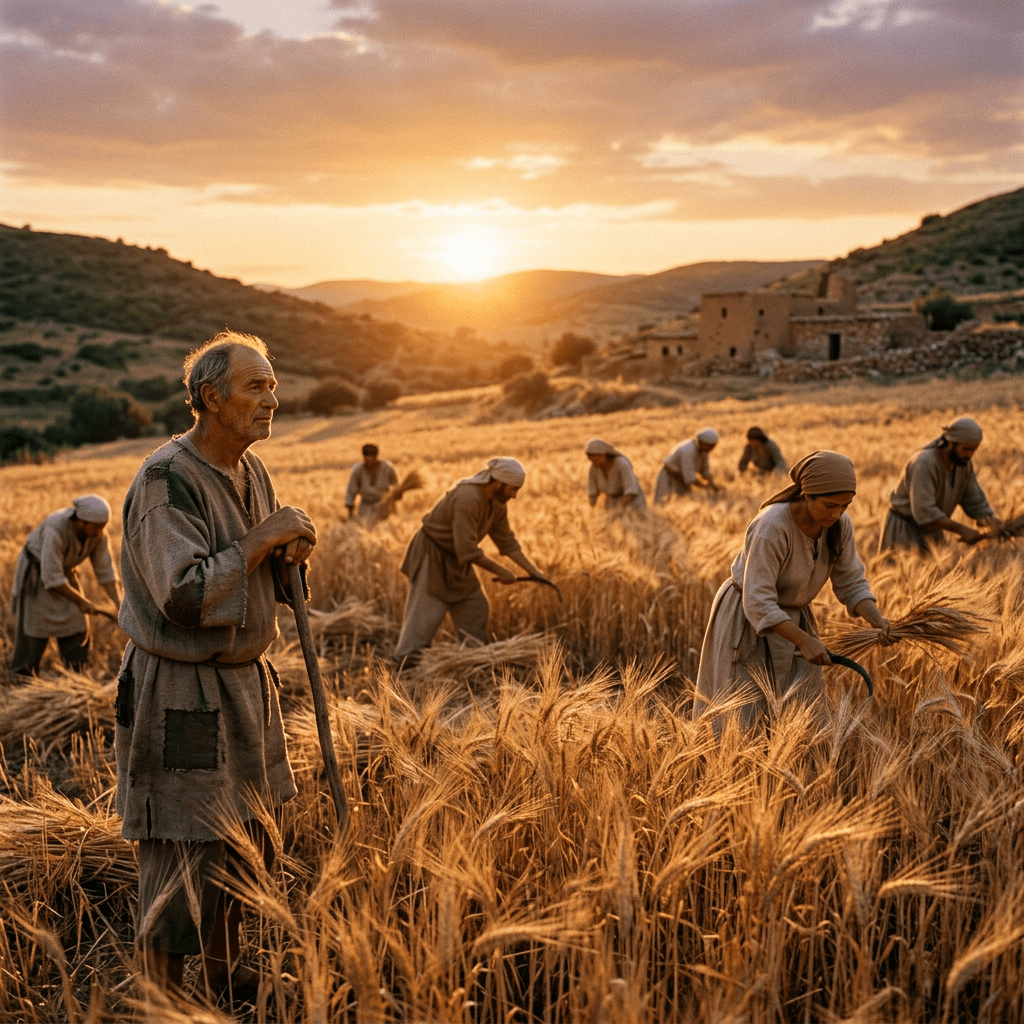
Boaz notices Ruth working.
This is not a trivial observation. Boaz is a wealthy landowner at harvest season — his fields are full of workers and overseers and the organized chaos of grain collection. He has legitimate business to attend to. He could walk the field and see only the harvest operation, which is what he came to inspect.
Instead he notices a woman he doesn’t recognize and asks his foreman who she is.
The foreman’s report is efficient: “She is the Moabite who came back from Moab with Naomi. She said, ‘Please let me glean and gather among the sheaves behind the harvesters.’ She came into the field and has remained here from morning till now, except for a short rest in the shelter.” (Ruth 2:6–7)
Boaz hears three things in that report. She is a foreigner, which means she has no natural claim on the land or the community. She is loyal — she came back with Naomi, which in context means she gave up her native country and her future prospects to honor a relationship with an old woman who had nothing left to offer her. And she works: she has been in the field since morning, she has not abused the gleaning privilege, she has not complained or sought special treatment.
Boaz then does something that is often under-read in the story. He doesn’t immediately approach her. He gives instructions to his men: leave extra grain in her path, let her drink from the water provided for the workers, do not rebuke or harass her. He creates a protected environment for her diligence to operate in before he introduces himself.
Then he speaks to her.
The Proverbs 31 Standard in Context
Proverbs 31:10–31 is one of the most frequently cited and most frequently misapplied passages in the Christian conversation about marriage.
It is often read as a checklist of female performance expectations — a standard against which women are measured and found adequate or inadequate. This is not what the passage is.
The passage is a poem — an acrostic, in Hebrew, each verse beginning with a successive letter of the alphabet. It is a description of a type of woman, not a hiring specification. The woman it describes is not extraordinary because she meets external criteria. She is extraordinary because of what drives her from the inside: “Charm is deceptive, and beauty is fleeting; but a woman who fears the Lord is to be praised.” (v. 30) Everything else in the poem is the outward expression of that inner orientation.
For the man reading this: what you are looking for is not a woman who ticks the boxes. You are looking for a woman whose fear of the Lord — whose genuine, lived orientation toward God — produces the qualities the poem describes as its natural fruit. Competence, industriousness, wisdom, care for the household, strength of character. These things flow from the root. If the root isn’t there, the fruit won’t hold.
And to be direct: a man who is himself not rooted in that fear of the Lord has no business applying this standard to anyone else.
The Campus Colosseum
The contemporary university environment presents a specific set of challenges for a young man trying to find the kind of woman this chapter describes.
The challenges are real and shouldn’t be minimized. The institutional culture of most universities actively works against the formation of the qualities Proverbs 31 describes. The social scripts on offer — casual sexual relationships, identity formation through ideological conformity, the valorization of personal autonomy over relational commitment — are not neutral. They are a counter-formation program, and they are effective over time on people who are not deliberately anchoring themselves to something else.
But Ruth was a Moabite. She was the foreigner in the Israelite field. She was not formed by Israelite culture — she was formed by her own choices and her loyalty to Naomi, which was itself a kind of faith commitment made before she had the full picture. She became who she was in an environment that was not designed to produce her.
The woman you are looking for may be in the field that doesn’t seem likely. She may be the one who is there from morning until now, working, not drawing attention to herself, not performing for an audience. Boaz didn’t find her at the city gate. He found her in the field.
You will not find a Proverbs 31 woman by hunting for one. You will find her the way Boaz found Ruth: by being present in the right places, doing the right work, and paying attention to who is doing the same.
What Boaz Did
Three things about Boaz’s approach that are worth studying.
He was a man of standing before he was a man of pursuit. Boaz is described as “a man of standing” (2:1) before Ruth appears in the story. He had built something. He had a reputation. The field he presided over was orderly and the workers respected him. He was not looking for a woman to complete him — he was a complete man who was available to the right relationship.
The man who approaches a woman from a position of need is putting the relationship under structural pressure before it begins. The work of becoming a man of standing — spiritually, vocationally, characterologically — is not preparation for finding a wife. It is preparation for life. A wife, if she comes, comes into a life that is already being built in the right direction.
He tested by observing before he acted. Boaz didn’t approach Ruth immediately. He watched. He gathered information from his foreman. He asked about her character and her history. He noticed how she worked. Then he created conditions for her to continue what she was doing, and he observed the results.
This is due diligence in the scriptural mode: not interrogation, not a formal vetting process, but patient observation of who a person actually is when they don’t know they’re being watched, and when they’re not performing for a potential partner.
He moved decisively when the time came. The book of Ruth covers multiple harvests. Boaz is patient but not passive — he is watching and waiting and honoring the appropriate process. When the moment arrives for him to act — the scene at the threshing floor, Naomi’s strategic intervention, Ruth’s bold claim — Boaz acts immediately. He resolves the legal complexity of the kinsman-redeemer situation the next morning. He does not delay out of uncertainty or self-protection.
The decisive man is the man who has done the observation work and knows what he wants and moves when the moment is there.
Prayer Raids, Not Foxhole Flings
The phrase in the original outline is “discern faith-queens via prayer raids, shunning fleeting foxholes.” Strip the metaphors: the fleeting foxhole is the relationship formed under pressure, in crisis, with the wrong person, because loneliness or desire made a compromise look like a solution.
Foxhole relationships produce real attachment and real pain and real damage to both parties. They are not simply unwise — they are training in the wrong direction. Every significant relationship shapes the way you relate in the next one. A string of foxhole relationships produces a man who has practiced intimacy-without-commitment enough times that genuine commitment becomes psychologically difficult.
Prayer is the operating discipline here not as a formula but as a mechanism of clarity. The man who is consistently bringing his desires and his observations before God is the man most likely to be honest about what he is actually seeing versus what he wants to see. Desire is not a reliable filter. Prayer, sustained over time, has a way of clarifying the gap between the two.
The practical question: is the woman you are considering someone you can pray with, honestly, about your actual life? Not a performance of spirituality — can you open your real circumstances and your real failures and your real fears before God in her presence, and does she do the same? If not, you do not know each other in the way that will be required by the years ahead.
A Prayer for Discernment
Lord, I want what Boaz had — not just the woman at the end of the story, but the character that was present long before she arrived. Make me a man of standing first: rooted, building, purposeful, at peace with who I am because I know Whose I am.
Give me Boaz’s patience to observe before I act, and his decisiveness to act when the time comes. Keep me from the fleeting foxhole — the compromise that looks like connection but produces only regret.
And where she is — in whatever field she is working in, from morning until now — let me have the eyes to see what Boaz saw: not performance, not presentation, but the fear of the Lord expressed in the daily work of a woman worth the cost of the commitment.
In the name of the One who loved the Church before she was worthy of it. Amen.
“A wife of noble character who can find? She is worth far more than rubies.” — Proverbs 31:10






 Lazarevic Ministries