CHAPTER TEN
On the morning of the resurrection, the disciples don’t believe it.
This is worth sitting with. These are not credulous people — they are first-century Jewish men and women who understood death as well as any people in history. They had watched the crucifixion. They knew what the Romans did, and they knew it worked. The report from the women at the empty tomb is greeted with skepticism bordering on dismissal: “their words seemed to them like nonsense.” (Luke 24:11)
Peter runs to the tomb anyway. He goes in, sees the burial cloths lying there, and comes out “wondering to himself what had happened.” (v. 12) Not yet faith. Wondering. The man who denied Christ three times before dawn is standing in front of an empty tomb and he doesn’t know what to do with it.
The faith comes later — incrementally, over forty days, through appearances in locked rooms and on roadsides and by lakeshores, each one building the evidence until the conviction is unshakeable. But it begins with a man who failed catastrophically, running toward the only thing that might mean he wasn’t finished.
Serbia’s Ottoman Resurrection
The year 1389 was not the end. This needs to be said plainly, because there is a romanticism around Kosovo that can make the defeat itself the destination — as if the highest expression of Serbian identity is the martyr’s death, full stop.
It isn’t.
The Kosovo defeat was followed by nearly five centuries of Ottoman rule. During those centuries: the Serbian Church preserved its canonical structure. The monasteries at Studenica, Žiča, Sopoćani, and Dečani continued to function as centers of learning, art, and spiritual formation. The hajduks kept the resistance alive in the forests. The guslars kept the Kosovo epic alive in the collective memory. The people kept crossing themselves and baptizing their children and burying their dead with Christian rites and praying in languages the empire couldn’t fully suppress.
In 1804, Đorđe Petrović — Karadjordje, Black George — led the First Serbian Uprising against the janissary commanders who had exceeded even the Ottoman government’s tolerance for brutality. It was the beginning of a process that ended in 1835 with the first Serbian constitution and the formal re-establishment of Serbian statehood.
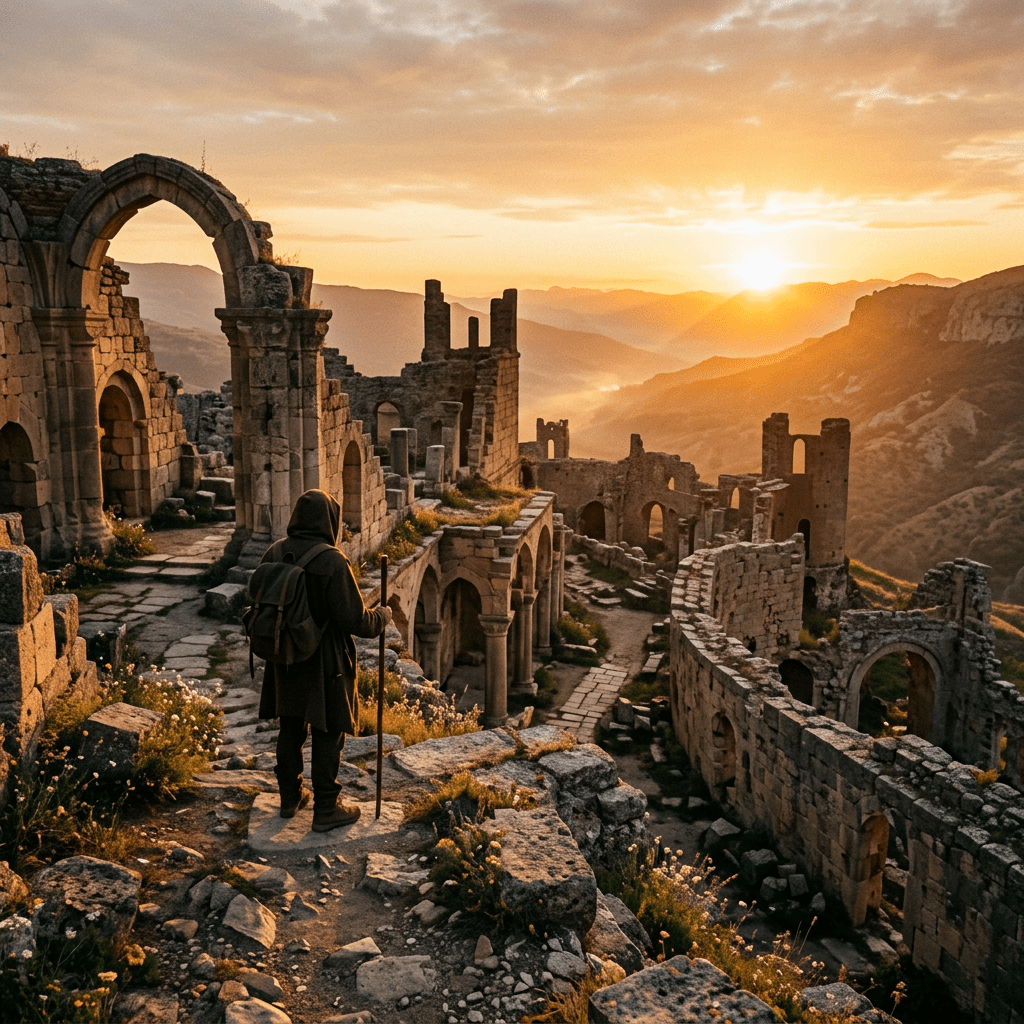
Four hundred and sixteen years after Kosovo. The root that the boot had tried to destroy had been growing through the long dark, and it came up through stone.
This is not incidental. This is the pattern of Christian history, expressed with particular intensity in the Serbian experience: death is not the end, defeat is not the final word, and the periods of burial are not waste — they are germination.
Lincoln at Gettysburg
On November 19, 1863, four and a half months after the battle, Abraham Lincoln stood in the new national cemetery on the Gettysburg battlefield and gave a two-minute address.
The Union had won the battle. But winning Gettysburg, in July 1863, had not felt like winning in any conventional sense. Fifty-one thousand casualties over three days. Fields that local farmers said smelled of death through the summer. A victory so costly that the North’s appetite for the war itself was in question.
Lincoln was speaking to a nation that had looked into the face of what its founding ideals actually cost and was not sure it could pay the bill. He did not address the doubt directly. He did something more audacious: he reframed the defeat embedded in the victory.
“From these honored dead we take increased devotion to that cause for which they gave the last full measure of devotion — that we here highly resolve that these dead shall not have died in vain.”
The dead shall not have died in vain. This is not a statement about the past — it is a charge about the future. Lincoln is saying: the meaning of this sacrifice is not fixed by what happened here. It is determined by what we choose to do now. The rubble of Gettysburg becomes the foundation for a renewed commitment to the nation’s unfinished work.
This is how personal defeats work in the hands of God — and in the hands of the man who refuses to let the failure be the final word.
Paul’s Thorn and the Arithmetic of Grace
“Therefore I will boast all the more gladly about my weaknesses, so that Christ’s power may rest on me.” (2 Corinthians 12:9)
Paul has just described an experience of the third heaven — a vision of revelation so extraordinary that he can barely describe it without disclaiming the description. And immediately following this account of transcendent spiritual experience, he discusses a “thorn in the flesh” that he prayed three times to have removed.
God’s answer: “My grace is sufficient for you, for my power is made perfect in weakness.”
This is the arithmetic that makes no sense by any normal calculation: the weakness is not the obstacle to God’s power operating through you. The weakness is the condition for it. Because when the power is operating through a man who is obviously insufficient — who everyone, including himself, knows does not have what it would take to accomplish what is being accomplished — the credit cannot go to the man.
This is Gideon’s three hundred applied to an individual life. The weakness is the thinning. God keeps it in place so that the victory will have the right explanation.
Every man reading this has a thorn. A persistent failure, a relational wound that doesn’t fully heal, a limitation that refuses to be overcome by harder work, a besetting sin that has been fought and fallen to and fought again. The prayer to have it removed is legitimate — Paul prayed it three times. But if the answer comes back “my grace is sufficient,” that is not a lesser answer than removal. That is the invitation to a different kind of power.
The thorn that teaches you to depend on God is more valuable than the capability you would have had without it. This is not a comfortable truth. It is a true one.
Pentecost and the Rebuilt Man
Peter stands up on the day of Pentecost and preaches to the crowd in Jerusalem — some of whom, almost certainly, were in the courtyard the night he denied Christ.
He does not preface the sermon with an apology. He does not perform public penance. He stands up, Spirit-filled, and delivers the most consequential sermon in Christian history. Three thousand people come to faith by the end of it.
This is not a man pretending the denial didn’t happen. This is a man who has been through the resurrection of his own failure — who sat with the risen Christ by the lakeside, was asked three times do you love me, received three times the commission feed my sheep, and understood that the triple restoration was not coincidental. It matched the triple denial. The wound was being healed in the same place it was inflicted.
The Pentecost sermon is not proof that the denial didn’t matter. It is proof that the denial was not the last word. The man who failed completely and came through the resurrection of forgiveness is more durable, more honest about his own insufficiency, and more useful to God than the confident man who hadn’t been tested yet.
This is what 2 Corinthians 12:9 is describing. The power is made perfect in the weakness — not despite it, but through it. The scar is not evidence of disqualification. It is the credential that makes the ministry possible.
Re-arming the Scars
The practical discipline of this chapter is the most personal one in the book.
Take the list you made in Chapter One — the Goliaths you named. Return to it now, at the end of this campaign, and add a column.
For each Goliath: what has this battle, even in its unfinished state, produced in you that you would not have without it? Not a silver lining. Not a consolation prize. The actual, specific quality that this specific fight has forged in you.
The addiction battle that you have fought and lost and fought again — what do you now know about your own limits, about God’s patience, about the nature of grace, that you did not know before? The fear that has paralyzed you — what has the process of pushing through it, even partially, revealed about your actual capacity? The doubt that has haunted you — what has sitting with it honestly, rather than suppressing it, produced in your understanding of faith?
The wounds become shields when they are understood clearly and carried intentionally. Not worn as badges of suffering for their own sake. Understood as the evidence of a campaign that is ongoing and whose outcome is not in doubt.
“We also glory in our sufferings, because we know that suffering produces perseverance; perseverance, character; and character, hope. And hope does not put us to shame, because God’s love has been poured out into our hearts through the Holy Spirit.” (Romans 5:3–5)
The chain holds. The hope at the end of it does not disappoint. Not because circumstances cooperate, but because the love of God has been placed at the interior of the man, and that love is the only thing in the universe that cannot be taken by force.
A Final Prayer from the Rubble
Lord, I am still standing. That alone is Your work, not mine.
The rubble around me is also Your material. You are the God who raises dead things — and You do not require me to clean up the mess before You start. Meet me here, in the actual state of things, and begin.
Restore what the years have taken. Re-arm the scars. Make of my particular history — its Kosovo defeats and its Pentecost mornings — something that serves the generation that comes after me, the brotherhood around me, and the work You prepared for me before I was born.
I have nothing to boast of except the cross. That is more than enough.
In the name of the One who rose from the worst rubble in history and made it the foundation of everything. Amen.
“My grace is sufficient for you, for my power is made perfect in weakness.” — 2 Corinthians 12:9



 Lazarevic Ministries