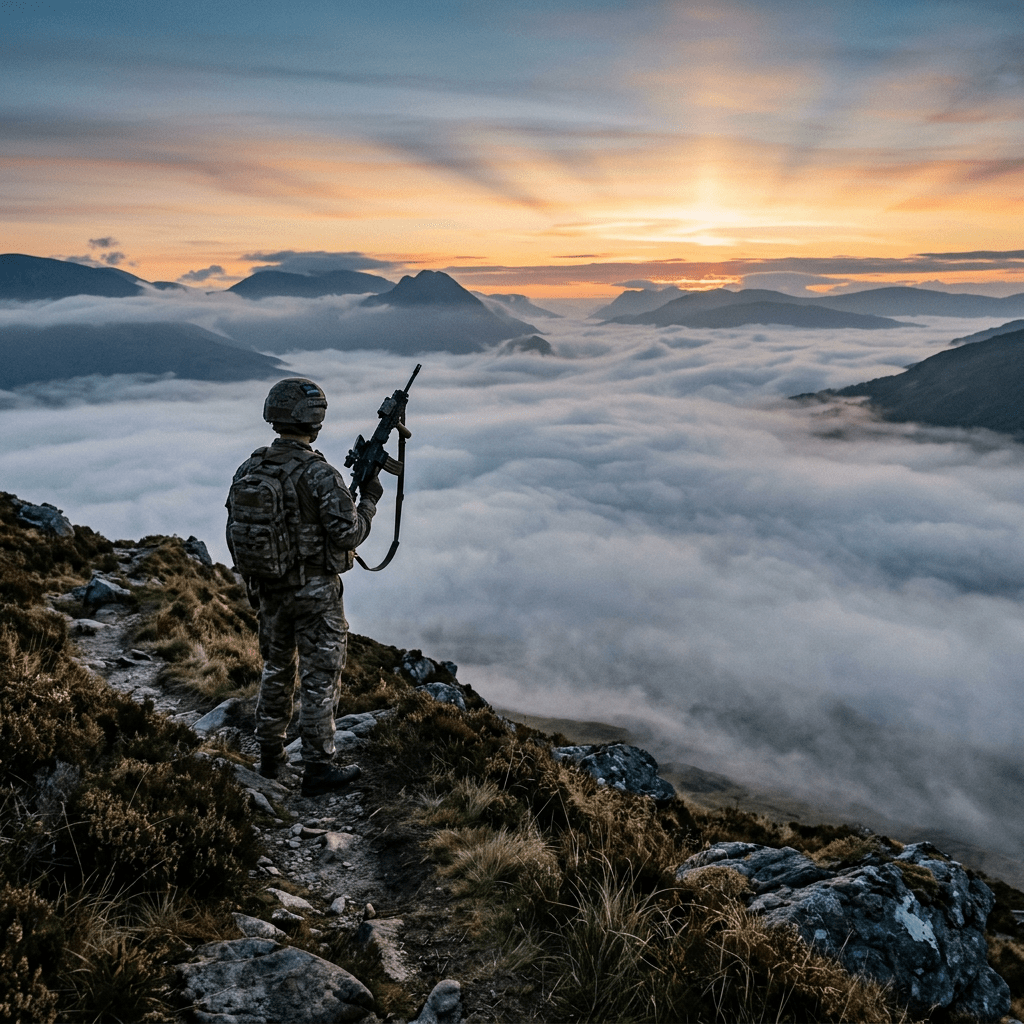
CHAPTER FOUR
The defeat at Ai came right after the greatest victory in the campaign.
Jericho had fallen perfectly — seven days of marching, seven trumpet blasts, one corporate shout, and the walls collapsed. No siege equipment. No casualties. Pure divine intervention in response to pure obedience. It was the kind of victory that could ruin a man if he wasn’t careful, because it suggested the campaign would keep working the same way.
It didn’t.
A man named Achan had taken forbidden plunder from Jericho — a robe, silver, gold, hidden in his tent. God’s covenant with Israel about the devoted things had been violated. When Joshua sent scouts to the small city of Ai and they came back with a confident report — “Not everyone needs to go; two or three thousand men are enough for this” (Joshua 7:3) — thirty-six men died in the assault and the Israelite army fled. Joshua fell facedown before the ark of the Lord, his military confidence shattered.
God’s response is not sympathetic: “Stand up! What are you doing down on your face?” (v. 10)
This is a remarkable rebuke. Joshua is prostrate in genuine anguish, and God tells him to get up. Not because the grief is inappropriate, but because there is a problem to be solved and mourning is not solving it. Find the sin. Remove it. Then go take the city.
Joshua does. Achan is identified and judged. The army returns to Ai. This time God gives Joshua a tactical plan — an ambush, a feigned retreat, a flanking force — and Ai falls completely.
Same city. Same army. Different outcome. Because the hidden thing was dealt with.
What Fear Actually Is
“For God has not given us a spirit of fear, but of power and of love and of a sound mind.” (2 Timothy 1:7)
Paul is writing to Timothy, who is young and has inherited a difficult assignment in Ephesus, and who appears to be genuinely afraid of what he’s been asked to do. Paul does not tell him not to feel the fear. He tells him where the fear is coming from — and it is not from God.
This distinction matters enormously.
There is a fear that is right and good: the fear of the Lord, the reverent recognition of what God is and what He requires. There is also the healthy fear that registers genuine danger — the physical signal that causes your body to prepare for threat. These are not the problem.
The fear Paul is addressing is different. It is the fear that paralyzes. The fear that makes a man lie facedown in front of the ark when he should be standing and solving the problem. The fear that keeps a man from taking the hill, leading his family, speaking the truth, making the hard call. This fear has a source, and its source is not God.
The sound mind that Paul offers as the alternative to this fear is worth examining. The Greek word is sophronismos — self-discipline, self-control, the capacity to govern one’s own responses rather than being governed by them. Fear becomes paralyzing when we let it drive. The courageous man is not the man who doesn’t feel fear. He is the man who feels it and drives anyway.
Gettysburg’s Long Ridge
July 2, 1863. The second day of the Battle of Gettysburg. The Union Army of the Potomac holds a fishhook-shaped defensive line on a series of ridges south of the town. At the southernmost hook — a rocky, wooded hill called Little Round Top — there is, in the late afternoon, a gap.
Colonel Joshua Chamberlain commands the 20th Maine Infantry, 386 men, positioned on the far left of the Union line. There is nothing to his left. If the Confederate forces flanking that position break through, they will roll up the entire Union line from behind, and the battle — possibly the war — will be lost.
The Confederates attack four times. Each time the 20th Maine holds. By the fourth assault, Chamberlain’s men are nearly out of ammunition, exhausted, with casualties mounting. He has perhaps 200 men still standing.
At this moment, Chamberlain does not order a defensive repositioning. He does not send for reinforcements. He orders a bayonet charge downhill into the fourth Confederate assault.
It works. The Confederates, expecting another defensive volley, are overrun by men with empty rifles who came at them with steel. Over 400 prisoners are taken. The left flank holds. The battle turns.
Chamberlain later described the decision with characteristic simplicity: he knew that to stay was to lose. The only option left was to move forward. So he moved forward.
This is the grammar of courage: when the defensive position has become untenable, when staying still is losing, when the only direction that offers any chance is straight into the fire — you move. Not because you’re unafraid. Because you’ve done the mathematics and attack is the only viable option.
What is your Little Round Top? Where are you holding a defensive position that is slowly bleeding you out — waiting for circumstances to change, waiting for permission, waiting for the enemy to stop pressing — when the only viable move is a bayonet charge downhill?
The Balkan Roar
There is a Serbian battle tradition called the bojni poklič — the war cry. Not decoration. Function.
The psychological literature on war cries confirms what warriors have known for millennia: vocalizing before and during combat raises aggression hormones, suppresses the cortisol spike of fear, and creates unit cohesion through synchronized physical action. The wall of sound is both a weapon against the enemy’s nerve and an anchor for your own.
“Za Srbiju! Za Hrista!” — For Serbia! For Christ! — is a declaration of what a man is willing to die for, shouted at the moment when dying becomes a real possibility. It functions the same way Joshua’s trumpets functioned at Jericho: it aligns the physical action with the spiritual reality behind it.
Every man needs his own version of this. Not necessarily a shout — the function can be served by a prayer, a passage of Scripture, a physical ritual that says: I know what I’m fighting for. I am not confused about whose side I’m on. I move.
Joshua’s commission before Ai — and before every city in the campaign — is repeated with minor variations throughout the book: “Be strong and courageous. Do not be afraid; do not be discouraged, for the Lord your God will be with you wherever you go.” (Joshua 1:9) God says it to Joshua. Moses had said it to Joshua before him. Joshua will say it to Israel before each engagement. The repetition is not redundancy — it is regrounding. Every charge needs to begin with the same orientation: Who is going with you into this?
The Hidden Achan
Before Joshua could take Ai, there was a reckoning.
The hidden thing in the tent — the forbidden plunder, the secret violation — had to be found and dealt with before the campaign could continue. As long as it was buried under the floor, no military strategy would work. The problem was not tactical. It was moral.
This is the part of the courage chapter that men most want to skip.
It is easier to talk about charging downhill with bayonets than to sit with the question: what is buried under the floor of my tent? What hidden compromise is quietly poisoning the ground beneath every effort you make to advance?
Not vague guilt. Specific. Buried. The agreement you made with yourself not to look at it too closely. The thing you’ve kept separate from your spiritual life because bringing it in would require actually dealing with it.
The camp cannot advance while it’s there. Not because God is vindictive, but because integrity is the load-bearing structure. A building with rotted joists looks fine until you put weight on it. The moment you try to advance — to lead, to build, to take ground — the hidden rot becomes structural.
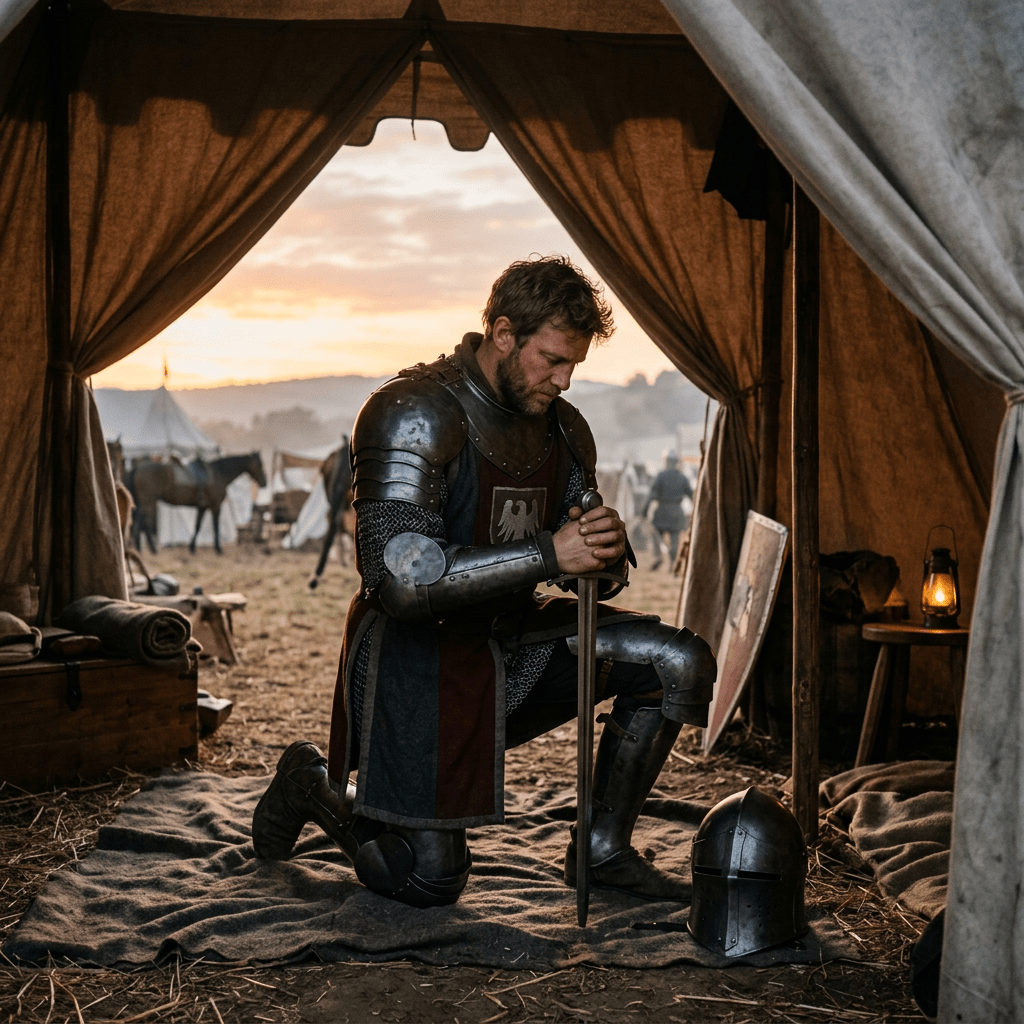
Joshua’s response to Ai was facedown grief followed by standing up and solving the problem. Both halves matter. The grief is honest. The standing up is obedience.
Courage exercise: Write down the thing you most do not want to write down. The Achan in your camp. Then write one specific action you will take this week to begin dealing with it — not to resolve it completely, but to stop hiding it. Surface it. Bring it to God and to one trusted person who can hold you accountable to resolution.
The hill is waiting. The flanking column is in position. But the charge cannot begin with something undealt with undermining the foundation.
After Ai: The Pattern of the Campaign
Here is what the rest of Joshua looks like after Ai falls: city after city, king after king, the land being taken territory by territory. The process is not always clean. There are setbacks, deceptions like the Gibeonite ruse, battles that are harder than expected. But the direction of the campaign does not reverse after Ai. Forward motion is restored and maintained.
This is what courage produces over the long arc: not a frictionless path, but sustained forward motion. The man who has dealt with his Achan and made the charge at the right moment does not necessarily have easy days after that. He has a direction. And the direction holds.
Paul, writing with the bone-deep authority of a man who has made the charge more than once: “I press on toward the goal to win the prize for which God has called me heavenward in Christ Jesus.” (Philippians 3:14) The word for press on is aggressive — it means to pursue, to chase down, to run hard after. Not to drift toward. To charge.
You have a direction. Identify the hidden thing, deal with it, then move.
A Prayer at the Ridge
Lord, I know what hill I’ve been standing on the wrong side of. I know what the Ai is in my life — the place I got routed and landed facedown and haven’t fully gotten back up from. I know what’s buried in the tent.
I don’t ask for the absence of fear. I ask for the power, the love, and the sound mind that Paul describes — the qualities that make fear an instrument rather than a driver. I ask for the courage of the 20th Maine, moving downhill when standing still was losing. I ask for Joshua’s obedience: deal with what’s hidden, then charge.
I am moving forward. In the name of the One who pressed toward Jerusalem knowing what was waiting there. Amen.
“Have I not commanded you? Be strong and courageous.” — Joshua 1:9



 Lazarevic Ministries