CHAPTER SIX
Solomon asks for the wrong thing.
Or rather — Solomon is in a position where he could ask for anything, and what makes the moment extraordinary is what he chooses not to ask for.
God appears to Solomon in a dream at Gibeon and says: “Ask for whatever you want me to give you.” (1 Kings 3:5) This is the blank check. Any king presented with this offer could be forgiven for asking for military dominance, long life, wealth, the destruction of enemies. Any of it would be understandable.
Solomon asks for wisdom.
More specifically: “Give your servant a discerning heart to govern your people and to distinguish between right and wrong.” (v. 9) The motivation he gives is humility squared: he describes himself as “a little child” who “does not know how to carry out his duties.” He is the king. He is calling himself a little child. He is saying, in the most direct terms available, that he knows he is not adequate for what he’s been asked to do.
God’s response is telling: because Solomon asked for wisdom rather than the things he could have asked for, God gives him wisdom and the things he didn’t ask for. The humility that produced the right request becomes the condition for the greater gift.
But the chapter begins before Solomon. It begins in a kill zone.
Lazar Kneeling
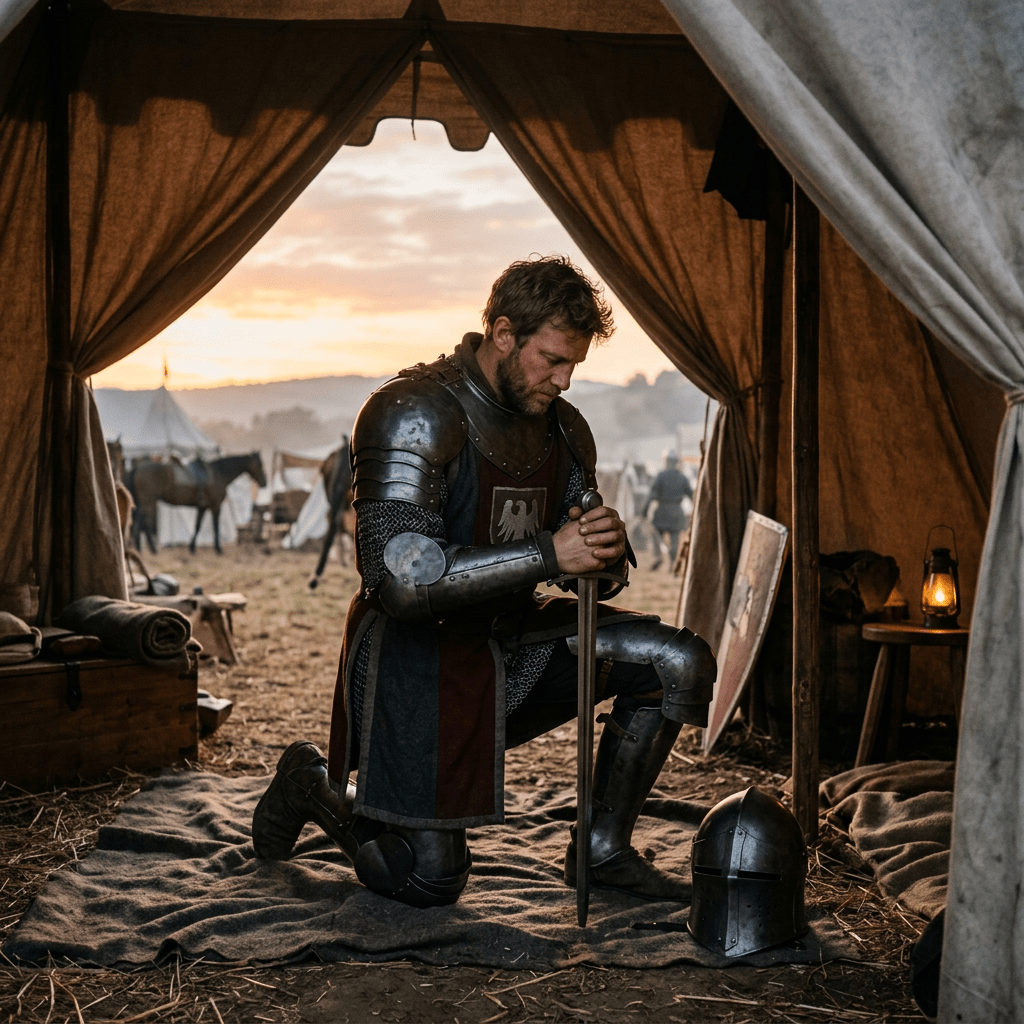
The night before Kosovo Polje, Prince Lazar made a choice that military logic cannot explain.
He could have submitted. He could have negotiated. He could have withdrawn north and preserved his army and his throne and his life, accepting the status of an Ottoman vassal like dozens of other Balkan lords had done. The outcome would have been undignified but survivable.
Instead, he knelt before an icon in his war tent and chose the heavenly kingdom.
This is not the act of a man who has lost hope. It is the act of a man who has achieved clarity. Lazar understood something that took six centuries to become fully visible in the historical record: the earthly kingdoms he might have preserved by submission rotted and were absorbed and disappeared. The spiritual legacy he left by choosing the cross over the crown became the founding myth of Serbian identity — a story that sustained a people through five centuries of occupation, two world wars, communist suppression, and the chaos of the 1990s.
He knelt in the kill zone. And the kneeling was the most powerful thing he did.
James’ Paradox
“God opposes the proud but shows favor to the humble. Submit yourselves, then, to God. Resist the devil, and he will flee from you.” (James 4:6–7)
Note the sequence. Submission to God comes before resistance to the devil. The order is not optional. A man who tries to resist evil from a position of self-sufficiency — his own strength, his own wisdom, his own plan — will find that the resistance has a ceiling. His strength runs out. His wisdom has blind spots. His plan doesn’t account for things he didn’t know.
The man who submits to God first — not as defeat but as strategic positioning — is drawing from a reserve that has no ceiling. He is placing himself under a command structure that has perfect intelligence, unlimited resources, and has already seen the end of the war.
This is not passivity. James’ sequence makes this explicit: after submission to God comes active resistance to the devil. The submission enables the resistance. The kneeling before God is what makes the standing against the enemy possible.
Lazar’s Kosovo choice is a military expression of James 4. He submitted to God’s kingdom first — we will not choose the earthly kingdom — and the resistance that flowed from that choice has never stopped. The Serbs who preserved their faith through Ottoman centuries were living out Lazar’s prayer. The families in Tito’s Yugoslavia who carved crosses into doorframes were living out Lazar’s prayer. The man who kneels before he charges is the most dangerous man on the field.
The Counterintuitive Weapon
Solomon’s wisdom story includes the famous case that demonstrates its quality: two women, one dead baby, each claiming the living child as her own. No witnesses. No evidence. No legal mechanism for resolution.
Solomon orders the child cut in half.
The real mother immediately surrenders her claim — “Please, my lord, give her the living baby! Don’t kill him!” — and the impostor agrees to the division. Solomon gives the child to the woman who would rather lose the case than lose the child.
The wisdom at work here is not cleverness. It is the ability to cut through the surface dispute to the actual human reality underneath. The legal question was whose child is this? The human question was who actually loves this child? Solomon bypassed the first question entirely by going directly to the second.
This is what humility produces in the daily life of a man with a family, a mission, a community: the ability to ask the actual question rather than the surface question. The humble man is not invested in being right. He is invested in being accurate. Because he doesn’t need the victory of the argument, he can sometimes see what proud men can’t — the human reality that the argument is obscuring.
The proud man needs the case decided in his favor. The humble man needs to know where the child actually belongs. These are not the same objective, and they produce radically different outcomes.
The Stripping
Every man who has been genuinely humbled — not humiliated, not broken by failure without recovery, but genuinely brought to the end of his own sufficiency — can identify the specific circumstance that did it.
It is rarely what he would have chosen. Job’s stripping was catastrophic and inexplicable. Paul’s thorn in the flesh was persistent and unresolved despite three specific requests for its removal. Peter’s humbling was public and devastating — the man who swore he would never deny Christ denied him three times before dawn, in front of witnesses, in the courtyard of the man who was about to order the crucifixion.
After the resurrection, Jesus finds Peter fishing — back to the old life, the pre-calling life, probably in genuine despair about whether he has any future after what he did. Jesus doesn’t address the denial. He asks one question, three times: “Do you love me?” Each time Peter answers yes, Jesus gives him an assignment. Feed my lambs. Take care of my sheep. Feed my sheep.
The restoration is in the commission. Peter is not restored by being told the denial doesn’t matter — it mattered enormously. He is restored by being trusted again, called again, assigned again. The humbling that the denial produced — the utter collapse of his confidence in his own loyalty — became the condition for a leadership that was more durable than the pre-denial version. Peter after Pentecost is a different kind of bold: not the impulsive boldness of a man who hasn’t been tested, but the settled boldness of a man who knows he failed, knows he was forgiven, and has nothing to prove to anyone.
The 1999 Wound as Altar
There is a particular temptation that comes with a deep wound inflicted by someone who should have been an ally. The temptation is to let the wound become an identity — to organize your life around the grievance, to make the betrayal the defining story.
NATO’s 1999 bombing of Serbia is that kind of wound in the American-Serbian relationship. The sons of the men Mihailović’s guerrillas rescued from Yugoslav mountains flew the planes that bombed Belgrade. The bridges that Serbian soldiers bled to defend against Hitler were shredded by American ordnance. That is not a small thing. It requires honest acknowledgment, not minimization.
But Lazar’s Kosovo choice offers a different way to hold a wound. He did not survive Kosovo to build his legacy around the betrayal of Vuk Branković. The Serbian tradition did not build its identity around grievance. It built its identity around the choice — the cross over the crown, the heavenly kingdom over the earthly one, the willingness to absorb the worst and still be faithful.
The 1999 wound belongs on an altar, not a banner.
On an altar: it is acknowledged, brought before God, used as the basis for a covenant that such a thing will never happen again, and transformed by prayer into the motivation for a bond that is stronger than the rupture that tested it.
On a banner: it becomes the organizing principle of an identity built on resentment — which is Sanballat’s tactic, not Nehemiah’s. Which produces a man who cannot be trusted with an alliance because he is perpetually relitigating the last betrayal.
Bring the wound to the altar. Let God do with it what He does — which is turn wounds into credentials, turn failures into foundations, turn betrayals into the evidence that the relationship is worth rebuilding because it has been tested.
“God opposes the proud but gives grace to the humble.” Humility toward the wound is not weakness. It is the only position from which reconstruction is possible.
The Surrender Drill
The practical discipline of this chapter is simple and deeply uncomfortable: identify the area of your life where you are most resistant to God’s authority. Not the area where you’re struggling and trying — the area where you have, consciously or unconsciously, decided that you know better.
It might be financial risk-taking that you’ve justified theologically. It might be a relationship you’ve chosen to maintain despite persistent conviction that it’s doing you harm. It might be a vision for your life that has slowly displaced the question of what God wants because you’ve decided you know what God wants. It might be unforgiveness, which is pride in its most durable form — the refusal to release a debt that God has already said should be cancelled.
Kneel there. Specifically. Not in general surrender, but in the precise location of resistance.
Lazar knelt before an icon in a war tent the night before the most important battle of his life. It was not a comfortable position. The battle was real, the odds were known, the cost was already visible on the horizon. He knelt anyway.
The field is waiting. But the kneeling comes first.
A Prayer of Surrender
Lord, I am, in the most honest assessment I can make, a little child who does not know how to carry out his duties. The things I am confident about are the things most likely to betray me. The wisdom I need is not an enhancement of what I already have — it is a replacement.
I bring the wound to the altar: [name it]. I bring the resistance to the altar: [name it]. I bring the pride that has dressed itself as principle and ask You to strip the costume off.
Give me Lazar’s clarity before Kosovo — the ability to choose the kingdom that endures over the one that looks like it matters right now. Give me Solomon’s willingness to say “I am a little child” and mean it. And give me the grace that flows from that position — which is, according to James, the only position from which it flows.
In the name of the One who, being God, became a servant. Amen.
“Humble yourselves before the Lord, and he will lift you up.” — James 4:10




 Lazarevic Ministries