CHAPTER NINE
The command in Deuteronomy 6 is given to Israel on the east bank of the Jordan, one day before the conquest begins.
Moses knows he will not cross the river. He gives this generation — the children of the wilderness wanderers, born after the exodus, knowing Egypt only as a story — the fullest articulation of what they are about to carry into the land. And the central anxiety of the passage is not military. It is generational.
“These commandments that I give you today are to be on your hearts. Impress them on your children. Talk about them when you sit at home and when you walk along the road, when you lie down and when you get up.” (Deuteronomy 6:6–7)
The warning is embedded in the passage in a way that should make every man who has built anything uncomfortable: “When the Lord your God brings you into the land… with large, flourishing cities you did not build, houses filled with all kinds of good things you did not fill, hewn cisterns you did not dig, vineyards and olive groves you did not plant — then when you eat and are satisfied, be careful that you do not forget the Lord.” (vv. 10–12)
The danger is not poverty. The danger is abundance. The generation that inherits without earning is the generation most at risk of losing what it inherited — because they did not pay the price that forged the conviction that produced the thing they now enjoy.
The Marko Kraljević Model
The Serbian epic cycle’s greatest figure is also its most effective teacher precisely because he is not sanitized.
Marko Kraljević’s stories work as transmission of values not because they present a flawless hero but because they present a complicated one making legible choices. A child hearing the epics around the fire did not learn this is what perfection looks like. He learned this is what a man looks like — the strength and the weakness together, the moment of failure and the return to what is right, the willingness to pay the cost when the cost becomes clear.
The guslars who transmitted these stories for centuries were doing the same work Moses prescribes in Deuteronomy 6: talking about it when you sit at home, when you walk along the road, when you lie down, when you get up. The transmission was not formal instruction. It was narrative woven into daily life until the values it carried became native to the listener.
What are the stories you are telling your children?
Not the bowdlerized versions where everyone does the right thing and it works out immediately. The true ones — including your own. The stories of what you got wrong and what it cost, what you believe and why you believe it, where the faith came from in your family and what it survived, what Kosovo means and why it still matters, what Halyard says about the kind of people your children come from.
Your dual-blood tales — American and Serbian, frontier and fortress, Reformation and Orthodoxy — are not background material. They are flint. Strike them against the steel of your children’s forming identity and throw sparks that land in the dry tinder of their inherited faith.
Titus’ Instruction
Paul writes to Titus with the field-commander’s efficiency: “Similarly, encourage the young men to be self-controlled. In everything set them an example by doing what is good.” (Titus 2:6–7)
The instruction to the older man is not primarily verbal. It is exemplary. Set them an example. The young men learn self-control not principally from lectures about self-control but from proximity to men who exercise it — men whose daily life demonstrates that appetite can be governed, that difficulty can be absorbed without self-destruction, that commitment can be maintained across the years.
This means the most important thing a father does for a son is to be the man he wants his son to become. Not perfectly — Marko Kraljević never resolved all his contradictions either. But directionally and demonstrably.
The Founding Fathers understood this as an institutional principle: the republic would only survive if each generation educated the next in the values that produced it. Jefferson wrote it. Adams wrote it. Washington embodied it in the voluntary surrender of power — the act that shocked the world and established the precedent that the republic was not a vehicle for personal ambition but a common inheritance to be tended and handed on.
What are you actively handing on? Not accidentally. Actively.
The Apprenticeship
Mentorship in the biblical tradition is not a program. It is proximity over time.
Elijah throws his cloak over Elisha and walks away. Elisha follows him for years — not learning in a classroom but watching, participating, carrying water, standing in the background of significant moments until his own moment comes. When Elijah is taken up in the whirlwind, Elisha asks for a double portion of his spirit. He gets it — because he was there to receive it, having stayed close long enough.
Paul writes to Timothy not as a program administrator but as a father: “I am reminded of your sincere faith, which first lived in your grandmother Lois and in your mother Eunice and, I am persuaded, now lives in you also.” (2 Timothy 1:5) The faith passed through women in Timothy’s household before it was developed through Paul’s instruction. The point is the chain: Lois to Eunice to Timothy to the churches of Asia Minor. Each link holding for the next one to form.
What does the chain look like in your family? Where did it hold? Where did it break — and what is required of you to re-forge it for the generation now in your household?
The Scars as Flint
Here is the instruction that is most likely to be resisted: your failures are part of what you pass on.
Not as confession that burdens children with adult weight. As evidence that the faith is real — real enough to survive failure, real enough to produce genuine repentance and recovery, real enough to be worth choosing when the cost is high.
Children who grow up with fathers who perform invulnerability learn that faith is a performance. They have no model for bringing their own failures to God, because they have never seen an adult do it honestly. When their own failures come — and they will — they have nowhere to take them.
The scar you are most reluctant to show may be the most useful flint in your quiver. Not detailed disclosure that crosses generational lines. But honest acknowledgment that the battle was real, that you went down, and that you got back up, and that what got you back up was this.
Your son will face his own Kosovo. He will face his own Ai. He will have his Delilah moments and his Valley Forge winters and his nights in the ditch before the invention finds its market. What he needs from you is not a guarantee that none of it will happen. He needs the template for what a man does when it does.
The Deuteronomy 6 Inventory
Three questions for this chapter:
What is on your heart? Not what you believe abstractly. What do you feel in the morning when you think about your children’s future — your genuine, daily, living concern for who they are becoming? If the answer is primarily about their external success — grades, performance, achievement — the inheritance you’re building is primarily material. The warning of Deuteronomy 6 applies directly.
What are you impressing on them? Not lecturing — impressing. What values, stories, commitments, and practices are being woven into the texture of daily life in your household? What do your children observe you doing when you think the stakes are low?
What will they know when they leave your house? Not what subjects they’ll have studied. What will they know about who they are, where they come from, what they believe and why, who they can call when they hit the wall at 3 a.m.? If the answer is unclear, clarify it now, while there is still time in the house.
A Prayer of Legacy
Lord, I received something worth passing on. I did not always protect it carefully. I have not always been the man at the front of the march that I wanted to be.
Give me Deuteronomy 6 faithfulness — the daily, unglamorous, repeated discipline of talking about what matters when we sit, when we walk, when we lie down, when we rise. Let the stories my children grow up hearing be true ones. Let my life be the template, scars and all, for what a man does with the faith when the road gets hard.
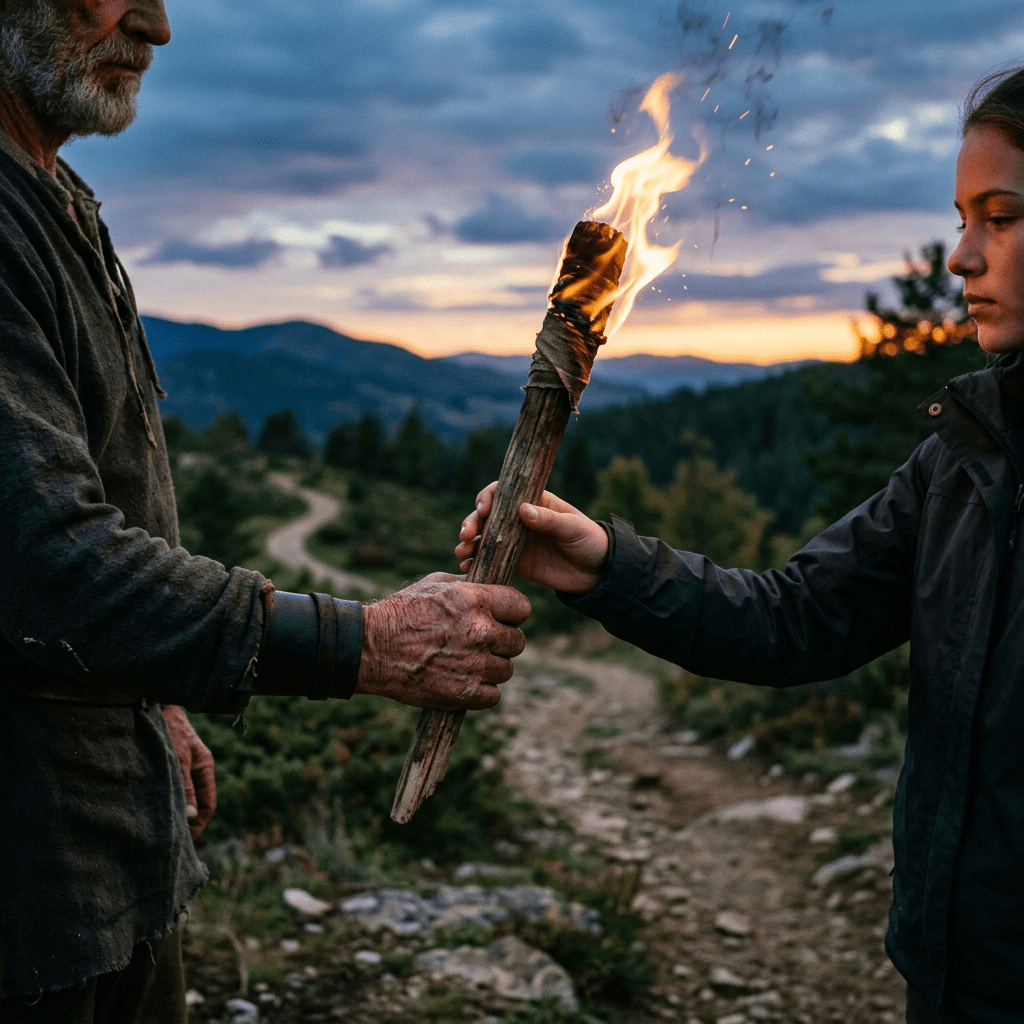
The torch is heavy. Keep my hands steady. In the name of the One who is the same yesterday, today, and forever — making the chain unbreakable from generation to generation. Amen.
“Impress them on your children. Talk about them when you sit at home and when you walk along the road.” — Deuteronomy 6:7




 Lazarevic Ministries